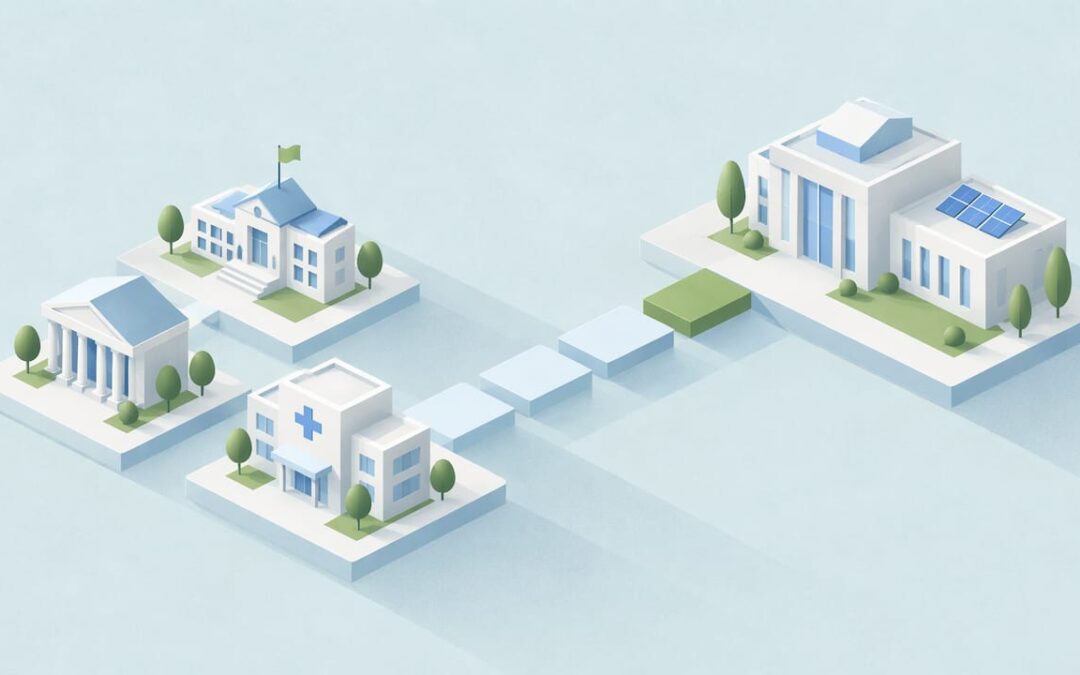
E-Rate eligibility has two parts. First, the applicant must be an eligible entity: a K-12 school, a school district, a library, or a consortium of those. Second, the purchase must be an eligible service used for educational purposes. Public and private K-12 schools and public libraries that meet the program’s definitions can apply, and the discount they receive runs from 20 to 90 percent depending on poverty level and urban or rural status. This guide explains each test, how discounts are calculated, and what to have on file when USAC reviews your application.
Key Takeaways
- Eligible applicants are schools that meet the statutory definition of an elementary or secondary school, libraries eligible under the Library Services and Technology Act (LSTA), and consortia made up of those entities.
- Eligible services fall into Category One (data transmission and Internet access) and Category Two (internal connections, managed internal broadband, and basic maintenance). Only services used for educational purposes qualify.
- Discounts range from 20 to 90 percent. They are driven by the share of students eligible for the National School Lunch Program (NSLP) and by urban or rural status.
- Being eligible does not mean being funded. You must still complete competitive bidding, file the right forms in the right order, and keep records for at least 10 years.
- The Eligible Services List changes by funding year, so always check the list for the year you are filing.
Table of Contents
- Who is eligible for E-Rate
- How eligibility is determined for your organization
- Which services are eligible
- How discounts and funding amounts are calculated
- What an eligibility review checks
- From eligible to funded: the sequence that matters
- Common eligibility mistakes
- Getting help with an eligibility review
- FAQ
- Sources
Who is eligible for E-Rate
The E-Rate program, formally the Schools and Libraries Universal Service Support program, is administered by the Universal Service Administrative Company (USAC) under the supervision of the FCC. USAC processes applications, confirms eligibility, and reimburses service providers and eligible applicants, according to the FCC’s E-Rate program page. Eligibility is decided entity by entity, so it helps to know which category yours falls into.
Schools and school districts
Public and private K-12 schools qualify when they meet the statutory definition of an elementary or secondary school under 20 U.S.C. § 7801. Two exclusions matter. According to USAC’s School and Library Eligibility page, schools that operate as for-profit businesses are not eligible, and neither are schools with endowments above $50 million.
Schools are eligible as a whole, and the application is usually filed at the district level. A district’s Billed Entity Number (BEN) covers the schools that belong to it. Independent private and charter schools generally file under their own entity records.
Libraries
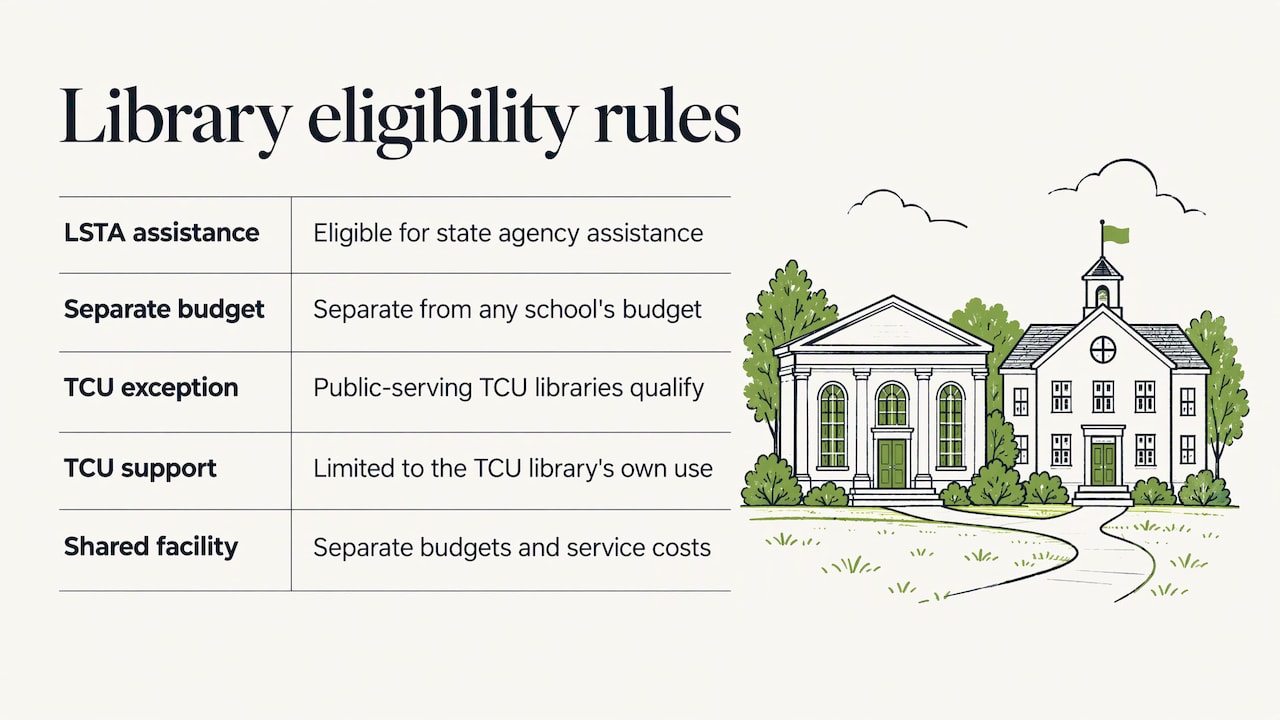
A library must be eligible for assistance from a State library administrative agency under the LSTA. Its budget must also be completely separate from any school’s budget. The exception is a Tribal College or University (TCU) library that serves the public, per the same USAC eligibility page.
That TCU exception is recent. The FCC adopted rules in 2023 (FCC 23-56, issued July 21, 2023) that extended eligibility to TCU libraries serving as public libraries. Support is limited to the TCU library’s own use, and cost allocation is required only when broadband support is requested for part of a network that serves the TCU, according to USAC’s 2026 Program Overview.
A common problem for library applicants is a shared building or shared network. If a library shares a facility with a school or another organization, the budgets and the cost of services have to be clearly separated before you file.
Consortia and statewide applications
A consortium is a group of E-Rate eligible entities that seeks competitive bids or E-Rate funding on behalf of its members. The consortium is not itself eligible for discounted services. It can run the competitive bidding process and apply for its members, whose own eligibility determines what is funded, per USAC’s 2026 Program Overview.
Educational service agencies and regional education cooperatives often play this role for small districts and libraries that lack procurement staff.
How eligibility is determined for your organization
There is no single “eligibility approval” step. Eligibility is established through your entity records and tested again when USAC reviews your funding requests. In practice, you confirm it in four places.
- Entity registration. USAC’s Get Started page lists the setup steps: obtain an FCC Registration Number (FCC RN), create an account in the E-Rate Productivity Center (EPC), and request a Billed Entity Number (BEN).
- Entity profile data. Your EPC profile records the entity type, student counts, NSLP data, and location. Errors here flow straight into the discount calculation.
- Urban or rural status. USAC bases this on the U.S. Census Bureau’s delineation. An urban area with a population of 25,000 or more is treated as urban for E-Rate, according to USAC’s Urban or Rural Status page.
- Service-level review. Each funding request is checked against the Eligible Services List for that funding year.
When entity data is wrong, the usual result is a reduced discount, delay, or a request for documentation. Cleaning up profiles before the filing window opens is cheaper than correcting them during review.
Which services are eligible
The FCC’s rules in 47 CFR Part 54 Subpart F divide supported services into two categories.
| Category | What it covers | How funding works |
|---|---|---|
| Category One | Telecommunications services, telecommunications, and Internet access, including data transmission | Discounted at the applicant’s rate; no per-student budget |
| Category Two | Internal connections, basic maintenance of internal connections, and managed internal broadband services | Discounted at the applicant’s rate, within a five-year pre-discount budget |
The rules also state that termination liability charges, penalty surcharges, and other charges not included in the cost of taking the service are not covered, per the same eCFR text.
The Eligible Services List
The specific products and services that qualify are described in the Eligible Services List (ESL), published for each funding year. According to USAC’s Eligible Services List page, the ESL is organized into Category One, Category Two, and a Miscellaneous section. It also states that only products or services used for educational purposes can be funded.
Two practical points follow from that.
- Eligibility depends on the funding year. An item that was eligible in one year may be described differently in the next. Read the ESL for the year in which services will start.
- Maintenance follows the equipment. Basic maintenance is eligible only when the equipment being maintained is itself eligible. A maintenance contract on ineligible gear is not supported.
Our E-Rate Services team reviews each line item against the current ESL before a Form 470 goes out. That way the services you bid are the services that can be funded.
Costs to separate out
Many contracts bundle eligible and ineligible items. Typical examples are a service plan that includes both eligible Internet access and ineligible extras, or an equipment quote that includes ineligible components. Ask providers to itemize their bids so that the eligible portion can be identified and cost-allocated. Without itemization, USAC may have to reduce a request or ask for clarification.
How discounts and funding amounts are calculated
Eligibility gets you into the program. The discount determines what the program pays.
The 20 to 90 percent range
The FCC states that E-Rate provides discounts of 20 to 90 percent of the cost of eligible services and equipment. The level depends on the level of poverty and on whether the school or library is urban or rural, per the FCC’s E-Rate page.
- Schools and districts: poverty is measured by the percentage of enrolled students eligible for free or reduced-price lunch under the National School Lunch Program.
- Libraries: poverty is based on the NSLP percentage of the public school district in which the library is located.
Both rules appear in 47 CFR Part 54 Subpart F.
Consortium discounts
For a consortium or statewide application, USAC lists each member with its individual discount, adds the discounts, and divides by the number of members to get an average. Consortia and statewide applications have no urban or rural status of their own, per USAC’s Calculating Discounts page.
What you still pay
The program is built so that applicants pay a share. USAC’s example: a library with a 90 percent discount buying $1,000 of eligible broadband services pays the 10 percent non-discount share, or $100, to the service provider. E-Rate covers the other $900, according to USAC’s 2026 Program Overview. Budget for your non-discount share before you sign a contract.
Category Two budgets and the annual cap
Beginning in funding year 2021, each eligible school, district, library, or library system has a budgeted amount of pre-discount Category Two support over a five-year cycle. That cycle resets in funding year 2026 and after every five funding years, per 47 CFR Part 54 Subpart F. If you have spent part of your earlier budget, confirm the remaining balance in EPC before planning a Category Two project.
Program funding is demand-based, up to an annual cap of $3.9 billion adjusted for inflation, according to the FCC. If demand were to exceed available funds, the FCC’s consumer guide says money goes first to the highest-poverty applicants and then to the next highest.
What an eligibility review checks
After you file an FCC Form 471, USAC reviews it for completeness, accuracy, and eligibility before issuing funding decisions. Reviewers commonly ask applicants to explain or document items such as the following.
- Entity status and data. Evidence that the school or library meets the definitions above, and that enrollment and NSLP counts match what you reported.
- Discount rate support. The source documents for your NSLP percentage and your urban or rural designation.
- Competitive bidding records. The Form 470 posting, bids received, evaluation criteria, and the reason a provider was selected.
- Contracts and service details. Signed agreements, pricing, and itemized costs that separate eligible from ineligible items.
- Cost allocation. How shared facilities or mixed-use services were divided.
- Educational purpose. That the service is used for educational purposes, as the ESL requires.
Exact requests vary by application, so answer each inquiry within its stated deadline and keep your responses consistent with your filed forms.
Record retention
Schools, libraries, and consortia must keep all documents related to the application for, receipt, and delivery of supported services for at least 10 years. The clock runs from the later of the last day of the funding year or the service delivery deadline for the request, per 47 CFR Part 54 Subpart F. A shared, organized folder for each funding year makes audits and reviews much easier to handle.
From eligible to funded: the sequence that matters
Eligibility alone does not release money. The steps on USAC’s Get Started page run in this order: register and set up EPC, competitively request bids, select a provider and sign a contract, apply for discounts when the filing window opens, certify when approved services begin, and meet the funding year deadlines.
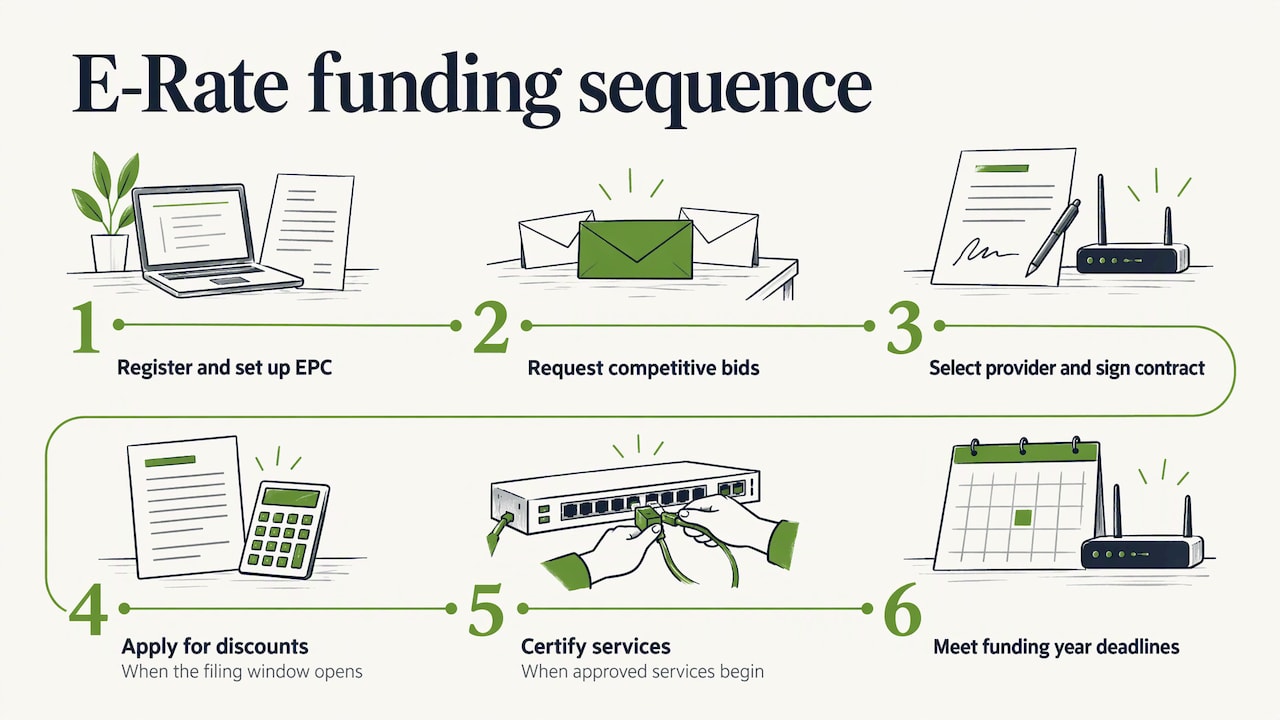
Timing rules deserve attention. According to USAC’s E-Rate Program Overview Guide, the FCC Form 470 must be certified at least 28 days before the FCC Form 471 is filed. After certification, USAC issues a Receipt Notification Letter with the Allowable Vendor Selection/Contract Date. The same guide notes that applicants confirmed to start services in July may be able to certify the FCC Form 486 early, on or before July 31 of the funding year, if requirements are met.
The funding year runs from July 1 to the following June. USAC notes that the program follows a static cycle set by FCC filing windows, but applicants can work with providers and plan throughout the calendar year, per its Get Started page. Check USAC’s site for the current window dates each year, since they change.
CIPA: an eligibility condition many applicants miss
Schools and libraries that receive E-Rate discounts for Internet access or internal connections must comply with the Children’s Internet Protection Act. The program overview guide warns that noncompliance may lead to funding denial or recovery of funds already disbursed, per USAC’s guidance. Our CIPA Compliance service covers policy review, staff training, and documentation so your certifications match what you actually do.
Common eligibility mistakes
- Assuming a library’s budget can be shared with a school. The budgets must be separate, with the TCU exception.
- Skipping the ESL check. Bidding a service that is not on the list for that funding year puts the request at risk.
- Using outdated enrollment or NSLP counts. An inaccurate discount rate affects every request you file.
- Bundled quotes. Providers that do not itemize force reviewers to guess at the eligible portion.
- Ignoring the 28-day rule. A Form 470 certified too late can push your whole filing back.
- Weak records. Missing bid evaluations or contracts are a frequent reason for follow-up questions.
For current program changes that affect applicants, see our E-Rate news and updates and our overview of E-Rate FY2026 updates and strategies. To see where your own requests stand, use our funding status lookup.
Getting help with an eligibility review
E-Rate eligibility touches entity records, procurement, cost allocation, and compliance, and an error in any one of them can slow funding. e2e Exchange manages the process from start to finish: application filing, proactive deadline management, document retention, and a dedicated support portal. That lets your administrators and technology staff stay focused on students.
If you want a second set of eyes on your entity data, service list, and bid documentation before the next filing window, contact our E-Rate team.
FAQ
Are private schools eligible for E-Rate?
Yes, private K-12 schools can be eligible if they meet the statutory definition of an elementary or secondary school. According to USAC, schools operated as for-profit businesses or with endowments above $50 million are not eligible. Private schools usually file under their own entity records.
Can a consortium receive E-Rate discounts directly?
No. A consortium can conduct competitive bidding and file applications for its members, but the eligible members receive the discounted services. Each member must itself be an eligible school or library, per USAC’s overview.
Where do I find the list of eligible services?
USAC publishes an Eligible Services List for every funding year on its Eligible Services List page. Use the list for the year in which your services will begin, and read the entry conditions, not just the product names.
What discount will my school or library get?
Discounts range from 20 to 90 percent. Schools are measured by NSLP eligibility among their students, and libraries by the NSLP percentage of their local public school district. Urban or rural status also plays a role, per the FCC.
How long do I have to keep E-Rate records?
At least 10 years after the later of the last day of the funding year or the service delivery deadline for the funding request, per federal rules.
Sources
- FCC: E-Rate Schools and Libraries USF Program
- FCC: E-Rate Universal Service Program for Schools and Libraries
- USAC: School and Library Eligibility
- USAC: E-Rate Program Overview 2026
- USAC: Eligible Services List
- USAC: Urban or Rural Status
- USAC: Calculating Discounts
- USAC: Get Started
- USAC: E-Rate Program Overview Guide
- eCFR: 47 CFR Part 54 Subpart F
Recommended
- E-Rate Updates May 2026: Major FCC Changes, Budget Increases & What Schools & Libraries Need to Know
- E-Rate Funding Year 2025 Wrap-Up & FY 2026 Updates: What Schools & Libraries Need to Know
- E-Rate FY2026: Key Updates, Deadlines & Strategies to Maximize Funding for Schools & Libraries
- E-Rate Industry Update: Major FCC Review Underway, Competitive Bidding Changes Coming, and What Schools & Libraries Need to Know Right Now (August 2026)