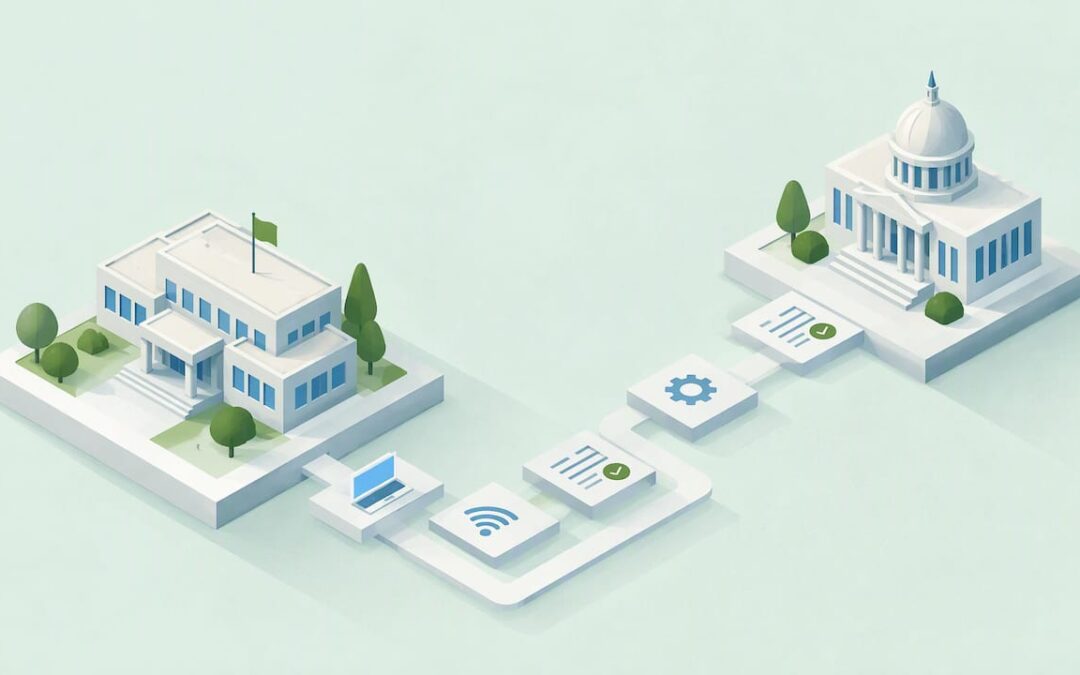
E-Rate consulting services take over the forms, bidding, deadlines, invoicing and record-keeping that come with the federal E-Rate program, so your staff are not running a multi-year compliance process alongside their regular jobs. A good consultant manages the work from competitive bidding through reimbursement. This guide explains what that covers, what district E-Rate management involves, where applicants most often go wrong, and how to decide whether outside help fits your school, library or educational service agency.
TL;DR
- E-Rate consultants draft RFPs, manage competitive bidding, prepare and file forms, handle program integrity inquiries, and assist with audits and appeals.
- The program offers discounts of 20% to 90% on eligible services, but applicants carry strict bidding, certification and 10-year record-retention duties.
- Missed deadlines, bidding errors, staff turnover and review delays are the most common causes of lost or delayed funding.
- Choose a consultant by scope (filing only or end-to-end), deadline management, compliance support and how they keep your records.
- We manage the full E-Rate cycle for K-12 schools, libraries and educational service agencies. See our E-Rate services.
Table of Contents
- What E-Rate consulting services actually include
- The E-Rate cycle a consultant manages
- District E-Rate management: how to organize the work
- E-Rate management challenges and how to reduce them
- Our perspective: why end-to-end management matters
- How to choose an E-Rate consultant
- Work with e2e Exchange
- Frequently asked questions
- Sources
What E-Rate consulting services actually include
The E-Rate program is run by the Universal Service Administrative Company (USAC) under FCC oversight. It gives eligible schools and libraries discounts of 20% to 90% on internet access, telecommunications and internal connections. The discount is real money. Earning it requires a sequence of steps, each with its own rules.
Consultants are hired to run that sequence. According to an EdTech Magazine guide to E-Rate, consultants can:
- draft RFPs and manage competitive bidding
- prepare and file the program forms
- handle Program Integrity Assurance (PIA) inquiries
- assist with audits and appeals
The range of service matters more than the list. Some firms only prepare forms. Others manage the whole cycle, including vendor selection, deadline tracking, invoicing and document retention. The difference shows up months later, when a PIA question arrives or an audit asks for a bid evaluation from three years ago.
Services around the E-Rate application
Districts that already work with an E-Rate consultant often need related compliance and funding work too:
- CIPA compliance. Applicants must certify compliance with the Children’s Internet Protection Act. That means technology protection measures (filtering) and an internet safety policy adopted after public notice and a hearing. Policy review and staff training are part of our CIPA compliance work.
- Grant funding strategy. E-Rate is one source among several. Our grant funding for schools guidance covers additional resources beyond E-Rate.
- Program-specific management. We also manage the California Teleconnect Fund, the Small Rural School Achievement (SRSA) grant program and the Emergency Connectivity Fund.
- Cyber safety and expense reduction. Cyber safety program implementation, state compliance and expense reduction audits sit alongside the E-Rate work.
The E-Rate cycle a consultant manages
USAC’s program overview breaks the process into stages. Knowing them tells you where a consultant adds the most value.
| Stage | What happens | Where errors tend to occur |
|---|---|---|
| Planning | Define needs, set a calendar, confirm who holds data such as lunch-program counts | Late starts, missing data owners |
| Competitive bidding (Form 470) | Post the request for services and evaluate bids under FCC and local procurement rules | Bid evaluation not documented, local rules overlooked |
| Funding request (Form 471) | Request discounts for the selected services | Wrong services, wrong entities, inaccurate figures |
| Service confirmation and CIPA (Form 486) | Confirm services have started and certify CIPA compliance | Missed filing, incomplete policy documentation |
| Invoicing | Reimbursement through BEAR or SPI | Mismatched amounts, delayed submissions |
| Retention and audit readiness | Keep program records for at least 10 years | Records scattered across staff and vendors |
The stages themselves come from USAC’s program overview: competitive bidding on Form 470, funding requests on Form 471, and service confirmation with CIPA compliance on Form 486. The error column reflects the patterns we see and the findings USAC publishes.
Two ways to get reimbursed
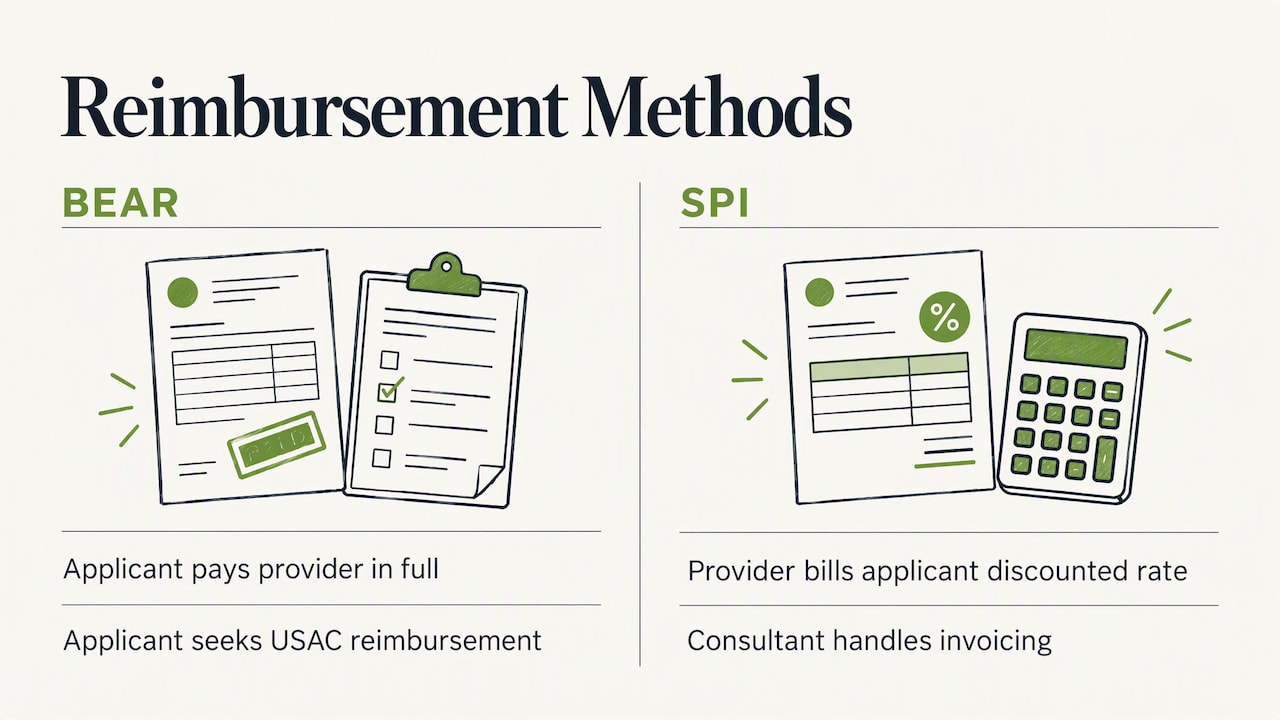
Reimbursement runs through one of two methods. With the Billed Entity Applicant Reimbursement (BEAR) method, the applicant pays the provider in full and then seeks reimbursement from USAC. With the Service Provider Invoice (SPI) method, the provider bills the applicant at the discounted rate. The choice affects cash flow, and it changes who is responsible for the paperwork. A consultant who handles invoicing keeps either path moving.
District E-Rate management: how to organize the work
Most districts do not have a full-time E-Rate specialist. The work lands on a technology director, a business official or a superintendent, and it recurs every year. Guidance in the EdTech Magazine guide says districts often assign an IT administrator or superintendent to oversee E-Rate, build a calendar of deadlines and milestones, and identify who holds information such as lunch-program data.
A workable internal structure looks like this:
- Name one owner. One person is accountable for the program, with a named backup.
- Build a calendar that works backward. Start from the filing deadlines and add lead time for contract negotiation and school board approvals. The same guide recommends a strategic calendar built this way.
- Map data owners. Student eligibility data, asset lists, vendor contracts and board minutes usually sit with different people.
- Centralize records. Keep bid documents, evaluations, contracts, invoices and CIPA materials in one place, because applicants must retain E-Rate records for at least 10 years.
- Plan for overlapping years. Funds for Learning’s Brian Stephens, quoted in the same guide, notes that districts often manage current, past and future funding years at the same time.
The fifth point is what stretches small teams. While you invoice one funding year, you are bidding for the next and answering questions about the last.
E-Rate management challenges and how to reduce them
USAC publishes common audit findings for the E-Rate program. Read them before your next filing. Practical experience points to the same group of problems:
- Missed deadlines. Each form has its own clock. A single missed date can cost a funding request.
- Bidding errors. Applicants must follow FCC competitive-bidding rules and applicable state and local procurement rules. Gaps in either can undermine an award.
- Staff turnover. When the one person who knows the process leaves, the knowledge leaves too, often mid-cycle.
- Review delays. PIA questions have response windows, and a slow answer can hold up a funding commitment.
- Thin documentation. Audit findings often come down to the district being unable to show what it did and why.
The remedies are unglamorous. Start early, keep a strategic calendar, standardize your records, and bring in a consultant where internal capacity is short. Our approach is built around each of these: proactive deadline management, accurate filing, and a dedicated support portal for documents and communication.
What the FCC is changing
The rules are not standing still. A 2026 FCC proposal would create a USAC-managed competitive bidding portal and repository starting with funding year 2028, and would reduce how often applicants must answer documentation requests. If it takes effect as proposed, bid records will move into a central system.
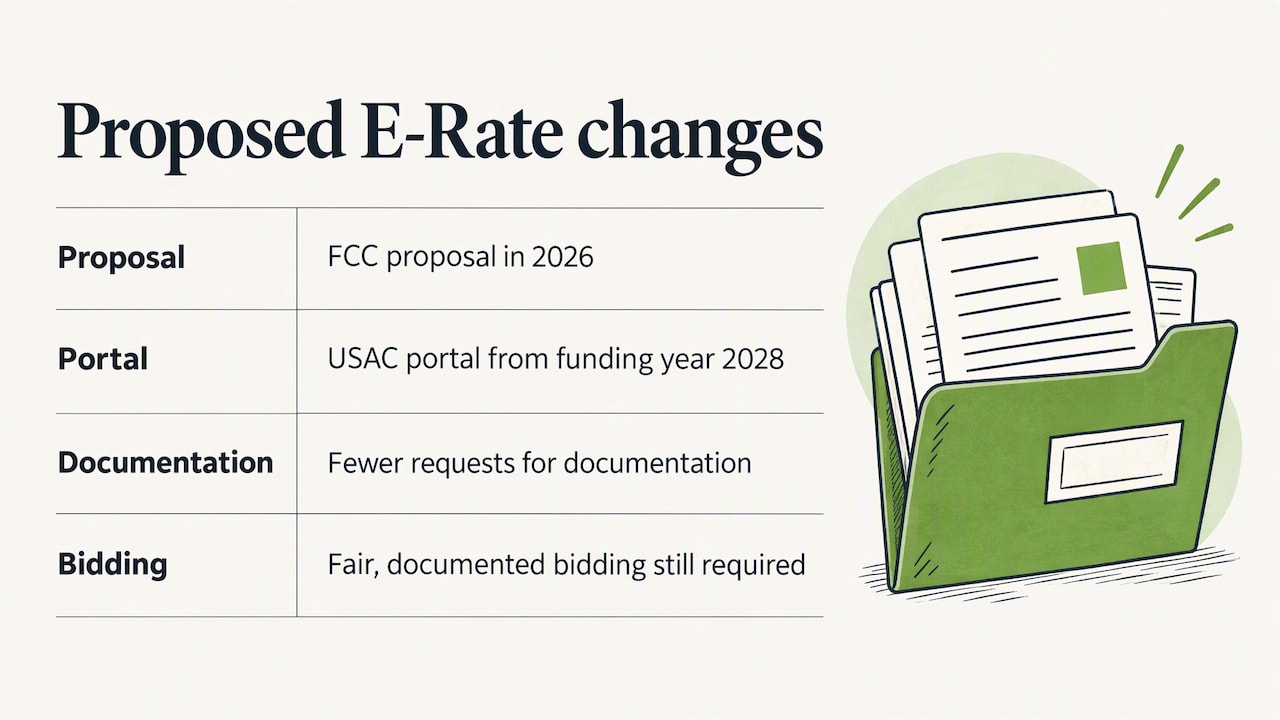
That is helpful, but it does not remove the need for a clear procurement process. Applicants will still have to run fair, documented bidding. Our news pages track the changes as they develop, including the 2028 bidding portal and planning for Funding Year 2027.
Our perspective: why end-to-end management matters
We see the same pattern in district after district. The application itself is rarely the problem. The trouble starts before it, when bidding is rushed, and after it, when invoicing and records are nobody’s job.
That is why we built our service around the whole cycle rather than a single form. We manage the E-Rate process from filing applications to securing reimbursements, with proactive deadline management and a dedicated support portal, so clients can fully hand off the administrative burden.
Our team brings together technology, finance and education experience. That matters because an E-Rate decision is a network decision, a budget decision and a procurement decision at once. We communicate openly and we keep documents in line with retention requirements, so an audit becomes a lookup rather than a scramble.
Our goal is simple: your funding is maximized, your compliance is accurate, and your staff are free to serve students.
Scott
How to choose an E-Rate consultant
The most useful question is whether outside help would save your district time and help it meet deadlines and requirements. If your answer to any of the following is yes, a consultant is likely worth it:
- One person holds all your E-Rate knowledge.
- You have missed or nearly missed a deadline in the past few years.
- You manage multiple schools, several service types or both E-Rate and other grant programs.
- You have received PIA or audit questions you struggled to answer.
- Your board or business office wants more predictable funding.
Then compare firms on these criteria:
| Criterion | What to ask |
|---|---|
| Scope | Do you handle bidding, filing, invoicing and appeals, or forms only? |
| Deadline management | Who tracks each date, and how will we be reminded and updated? |
| Compliance depth | Do you cover CIPA, state requirements and procurement rules? |
| Records | Where are our documents kept, and how do you meet the 10-year retention rule? |
| Audit support | Will you help us respond to PIA inquiries, audits and appeals? |
| Pricing structure | Is it per project, by organization size, or an ongoing engagement? |
| Communication | Do we get a portal, a named contact and clear status updates? |
A consultant is a partner in your procurement, so independence matters. Ask how vendor selection is handled and how the bid evaluation is documented. The answer should show a process you could explain to an auditor.
Work with e2e Exchange
We are a consulting firm dedicated to E-Rate compliance for K-12 schools, libraries and educational service agencies. We handle the process from application filing to funding reimbursement, with deadline management, accurate compliance and a support portal built in. Schools working with us have received millions in funding. Our fees are structured per project, organization size or ongoing engagement.
If you want to see how your district’s current process compares, start with our E-Rate consulting services page, or contact us through our main site. You can also check where your applications stand with our funding status lookup tool.
Frequently asked questions
What do E-Rate consulting services cost?
Pricing depends on the scope of work, the size of the organization and whether the engagement is a single project or ongoing. We structure our fees per project, by organization size or as an ongoing engagement. Contact us with your entity count and the funding years you need covered, and we will scope it with you.
Can a small district manage E-Rate without a consultant?
Many do, particularly when one trained person owns the process and records are well kept. The risk is concentration: when that person is out or leaves, deadlines and bid documentation are exposed. Small teams often bring in a consultant for specific stages, such as competitive bidding or invoicing, or hand off the whole cycle.
What records do I need to keep for E-Rate?
Applicants must maintain E-Rate records for at least 10 years. That generally includes the bidding documents, bid evaluations, contracts and invoices behind each request. Your consultant should store or index these so they can be produced quickly in an audit.
Does E-Rate consulting include CIPA compliance?
It can. Applicants certify CIPA compliance, which requires filtering and an internet safety policy adopted with public notice and a hearing. We offer CIPA compliance consulting covering policy review, staff training and an online portal.
When should we start planning for the next funding year?
Early. Work backward from the filing deadlines and add time for contract negotiation and board approvals. USAC sets the filing window each year, so check its official announcements for current dates, and follow our E-Rate news updates for planning guidance.
Sources
- Schools and Libraries (E-Rate) Program Overview, USAC
- A Guide to E-Rate, EdTech Magazine
- Common Audit Findings: E-Rate Program, USAC
- FCC document on the competitive bidding portal proposal
Recommended
- E-Rate Industry Update: Major FCC Review Underway, Competitive Bidding Changes Coming, and What Schools & Libraries Need to Know Right Now (August 2026)
- E-Rate Funding Year 2025 Wrap-Up & FY 2026 Updates: What Schools & Libraries Need to Know
- CIPA Compliance Services: Protect Your E-Rate Funding and Ensure Internet Safety for Students
- E-Rate FY2026: Key Updates, Deadlines & Strategies to Maximize Funding for Schools & Libraries