
E-Rate Compliance: Safeguard Your E-Rate Funding and Avoid Costly Errors
E-Rate provides schools and libraries with valuable funding to help offset the cost of internet access, telecommunications, and network infrastructure. However, receiving E-Rate funding involves more than simply submitting an application. Applicants must meet ongoing FCC and USAC requirements, follow competitive bidding rules, meet strict filing deadlines, and maintain accurate documentation throughout the funding year.
Failure to meet these requirements can result in reduced funding, denied applications, delayed reimbursements, or even the recovery of previously committed funds.
Managing E-Rate compliance can be complicated and time-consuming, particularly for organizations with limited administrative resources. e2e Exchange provides comprehensive E-Rate management services to help schools and libraries navigate program requirements, protect their funding, and minimize the administrative burden on staff.
Key Takeaways
- E-Rate discounts of 20% to 90% are paid only to applicants whose bidding, filings and invoices follow FCC and USAC rules, so compliance protects the funding itself.
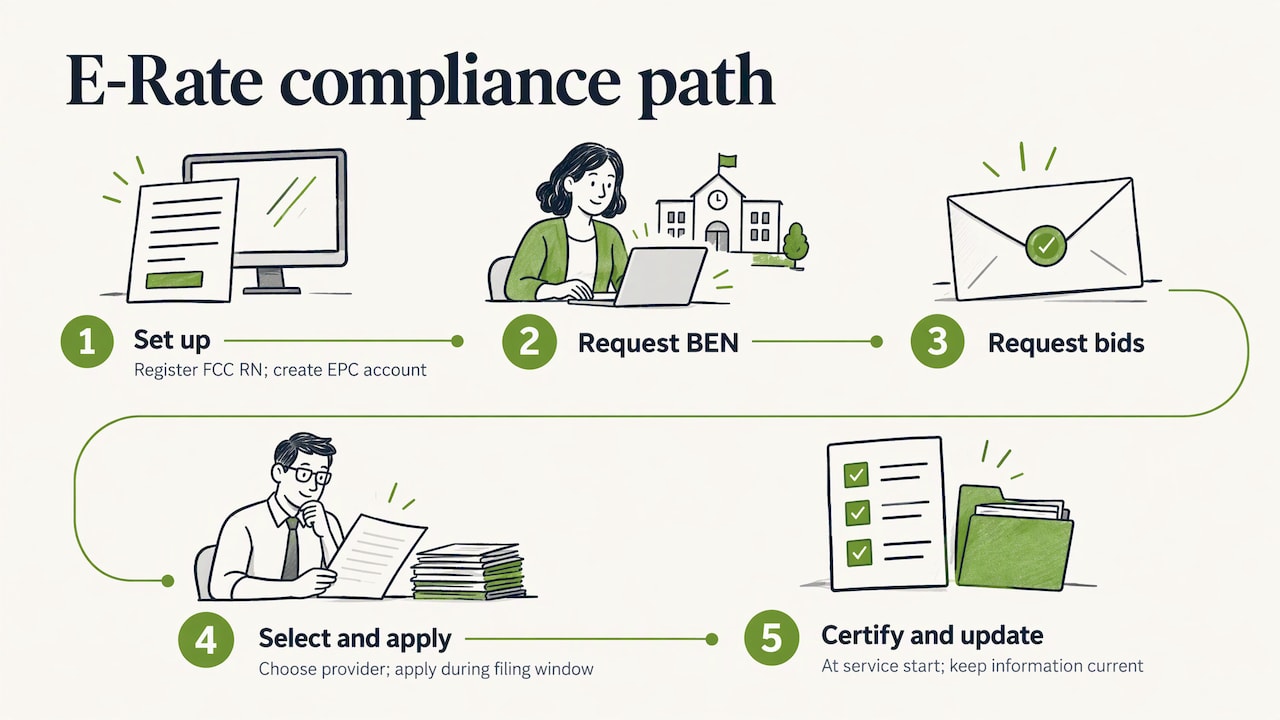
- Every step has its own form and clock: Form 470, a 28-day bidding wait, Form 471, Form 486, then invoicing. A missed date can reduce or end a commitment.
- Records must be kept for 10 years after the later of the funding year’s end or the service delivery deadline, and responsibility stays with the applicant.
- Rules change. In 2025 the FCC rescinded support for off-premises Wi-Fi hotspots, which shows why eligibility needs checking each funding year.
- Full-service E-Rate Compliance turns a seasonal scramble into a year-round routine with deadlines tracked and documents filed.
Table of Contents
- Understanding E-Rate Compliance
- Why E-Rate Compliance Matters
- Common E-Rate Compliance Challenges
- E-Rate Record Retention Requirements
- Keeping Up With E-Rate Program Changes
- Why Schools and Libraries Choose e2e Exchange
- Frequently Asked Questions
- Sources
Understanding E-Rate Compliance
The federal E-Rate program provides eligible schools and libraries with discounts ranging from 20% to 90% on qualifying telecommunications, internet access, and internal connections services. Funding is determined by factors such as poverty levels and whether an organization is located in an urban or rural area.
To receive and retain E-Rate funding, applicants must comply with FCC regulations and USAC requirements throughout the entire funding process.
E-Rate compliance encompasses several important responsibilities:
- Eligibility: Ensuring the organization, requested services, and equipment meet current E-Rate requirements.
- Competitive Bidding: Following FCC procurement requirements and documenting a fair and open vendor selection process.
- Application Filing: Submitting accurate FCC Forms 470 and 471 within established filing windows.
- Funding Commitments: Monitoring USAC decisions, responding to Program Integrity Assurance (PIA) inquiries, and completing required certifications.
- Invoicing and Reimbursements: Meeting service delivery and invoicing requirements to receive approved funding.
- Record Retention: Maintaining supporting documentation for the required retention period.
These responsibilities extend beyond the initial application. Compliance must be maintained throughout the funding year and beyond.
Why E-Rate Compliance Matters
E-Rate funding can represent a significant portion of a school’s or library’s annual technology budget. Even small administrative errors can create problems that jeopardize funding.
Competitive bidding violations, inaccurate application information, missed certification deadlines, and improper invoicing can result in funding reductions or denials.
Applicants must also understand that compliance responsibilities do not end once USAC issues a Funding Commitment Decision Letter (FCDL). Organizations must continue to meet program requirements, document eligible services, complete required certifications, and submit invoices within the applicable deadlines.
Having an experienced E-Rate management partner helps reduce the risk of costly mistakes and ensures that important requirements do not get overlooked.
Don’t risk losing valuable E-Rate funding because of missed deadlines, filing errors, or compliance issues. e2e Exchange helps manage the process from application preparation through funding reimbursement.
Common E-Rate Challenges
E-Rate involves multiple forms, deadlines, procurement requirements, and ongoing administrative responsibilities. For many schools and libraries, managing these obligations internally can be challenging.
Some of the most common E-Rate compliance concerns include:
Competitive Bidding Requirements
The FCC requires applicants to follow specific competitive bidding procedures, including a minimum 28-day bidding period and appropriate documentation of the vendor selection process. Price must be the primary factor when evaluating bids. Improper procurement practices or incomplete documentation can jeopardize funding.
Application Errors and PIA Reviews
USAC reviews applications to verify eligibility and compliance. Applicants may receive Program Integrity Assurance (PIA) inquiries requesting additional information or documentation. Incomplete or inaccurate responses can delay funding decisions or result in funding reductions.
Missed Filing and Certification Deadlines
E-Rate has multiple filing and certification deadlines throughout the funding year. Missing a Form 486 deadline or submitting invoices after the applicable deadline can result in lost funding.
Invoicing and Reimbursement Requirements
Applicants must follow USAC’s invoicing procedures to receive their approved discounts. Understanding the BEAR and SPI invoicing methods, maintaining accurate banking information, and submitting invoices on time are all important parts of compliance.
Staff Turnover and Administrative Burden
E-Rate responsibilities often involve multiple departments, including technology, finance, purchasing, and administration. When program knowledge and documentation are maintained by only one employee, staff turnover can create significant compliance gaps.
Having an experienced E-Rate consultant manage these responsibilities helps provide continuity, organization, and accountability throughout the funding process.
E-Rate Record Retention Requirements
Record retention is one of the most important and frequently overlooked aspects of E-Rate compliance.
FCC regulations generally require applicants, service providers, and consortia to retain documentation for 10 years after the later of the last day of the funding year or the service delivery deadline.
Records should support all aspects of the E-Rate process, including:
- FCC Forms 470 and 471 and supporting application documentation.
- Requests for Proposals (RFPs), bids, and vendor communications.
- Bid evaluation records and vendor selection documentation.
- Contracts and service agreements.
- Funding commitment letters and USAC correspondence.
- Service delivery and payment records.
- Invoices and reimbursement documentation.
- Category Two equipment and inventory records.
These records may be requested during USAC reviews, FCC audits, or other compliance investigations.
Because the retention period extends well beyond an individual funding year, maintaining complete and organized documentation is essential. Schools and libraries should have a reliable system that allows records to remain accessible even when staff or administrators change.
e2e Exchange helps clients maintain organized E-Rate documentation and supporting records through our dedicated client support portal, making important information easier to access when needed.
Keeping Up With E-Rate Program Changes
E-Rate requirements and eligible services can change as the FCC issues new orders, modifies program rules, and updates the Eligible Services List.
For example, the FCC’s September 30, 2025 Order on Reconsideration rescinded the rules allowing E-Rate support for off-premises Wi-Fi hotspots. This change affected applicants who had included hotspot services in their funding requests.
Changes like these demonstrate why schools and libraries cannot assume that services eligible in one funding year will remain eligible in the next.
Staying informed about FCC and USAC updates is important when planning technology purchases, developing procurement strategies, and preparing funding applications.
e2e Exchange monitors E-Rate program developments and helps clients understand how regulatory changes may affect their applications, funding requests, and ongoing compliance responsibilities.
Why Schools and Libraries Choose e2e Exchange for E-Rate Compliance
Managing E-Rate requires specialized knowledge, consistent attention to deadlines, and an understanding of constantly evolving program requirements. For many organizations, handling the entire process internally takes valuable time away from their primary responsibilities.
e2e Exchange provides comprehensive E-Rate management services, helping schools, libraries, and educational service agencies manage their funding from beginning to end.
Our services include:
- Application Preparation and Filing: Accurate preparation and submission of required E-Rate applications.
- Competitive Bid Management: Assistance with Form 470 filings, procurement requirements, bid evaluations, and supporting documentation.
- PIA Support: Assistance responding to USAC inquiries and requests for additional information.
- Funding Commitment Monitoring: Tracking application reviews, funding decisions, and outstanding requirements.
- Invoicing and Reimbursements: Managing BEAR and SPI invoicing requirements and reimbursement deadlines.
- Deadline Management: Proactive monitoring of important filing, certification, and invoicing dates.
- Compliance and Record Retention: Maintaining organized documentation and supporting records throughout the process.
- Ongoing Client Support: Providing guidance and communication as program requirements and funding needs evolve.
With e2e Exchange managing the administrative responsibilities, your staff can spend less time navigating E-Rate requirements and more time focusing on your organization’s technology needs.
Our goal is to help clients maximize available E-Rate funding while maintaining compliance and avoiding unnecessary administrative complications.
Let e2e Exchange Manage Your E-Rate
E-Rate funding is too important to risk application errors, missed deadlines, procurement issues, or incomplete documentation.
Whether you need assistance with competitive bidding, application filings, PIA inquiries, funding commitments, or reimbursements, e2e Exchange can manage the entire E-Rate process for your organization.
Contact e2e Exchange today to learn how our full-service E-Rate compliance solutions can help protect your funding, simplify compliance, and reduce the workload on your staff.
Visit www.e2eexchange.com to get started.
Frequently Asked Questions
What is E-Rate compliance?
This means following FCC and USAC program requirements for eligibility, competitive bidding, application filings, funding certifications, invoicing, and record retention. Applicants must remain compliant throughout the funding process to receive and retain their approved discounts.
What happens if an organization does not comply with E-Rate requirements?
Noncompliance can result in denied or reduced funding, delayed reimbursements, recovery of previously committed funds, or other compliance actions. Common problems include missed deadlines, improper competitive bidding, inaccurate applications, and insufficient documentation.
How long must E-Rate records be retained?
Most E-Rate documentation must be retained for 10 years after the later of the last day of the funding year or the service delivery deadline. Category Two equipment inventory records have separate 10-year retention requirements measured from the date of purchase.
Does hiring an E-Rate consultant eliminate an applicant’s compliance responsibilities?
No. The applicant remains responsible for meeting FCC and USAC requirements, even when using an outside consultant. However, an experienced E-Rate management company can help organize the process, monitor deadlines, prepare applications, and maintain supporting documentation to reduce compliance risks.
What E-Rate services does e2e Exchange provide?
e2e Exchange offers comprehensive E-Rate management services, including competitive bidding, Forms 470 and 471, PIA inquiries, funding commitment monitoring, Form 486 certifications, invoicing, reimbursements, and ongoing compliance support.
Why should schools and libraries use an E-Rate consultant?
E-Rate involves complex regulations, multiple filing deadlines, and ongoing documentation requirements. An experienced consultant helps manage these responsibilities, reduce administrative workloads, avoid preventable mistakes, and ensure organizations are positioned to receive the funding for which they qualify.
Sources
- FCC: E-Rate Schools & Libraries USF Program
- FCC consumer guide: E-Rate
- USAC: Beginning E-Rate Services 2026 webinar
- FCC Order on Reconsideration, September 30, 2025
Recommended
- E-Rate Funding Year 2025 Wrap-Up & FY 2026 Updates: What Schools & Libraries Need to Know
- E-Rate FY2026: Key Updates, Deadlines & Strategies to Maximize Funding for Schools & Libraries
- E-Rate Consulting Services
- E-Rate Industry Update: Major FCC Review Underway, Competitive Bidding Changes Coming, and What Schools & Libraries Need to Know Right Now (August 2026)