FCC Cybersecurity Pilot Program
The FCC’s Schools and Libraries Cybersecurity Pilot Program is a three-year, up to $200 million effort, run by USAC under FCC oversight, to test whether Universal Service funds should help schools and libraries pay for cybersecurity. Applications are closed. Selection is complete and, according to USAC’s October 2026 newsletter, all funding commitment letters have been issued. If your school, library or consortium was selected, the work now is invoicing correctly, keeping records, meeting CIPA and filing annual reports. If you were not selected, the pilot is still the template for what a permanent program could look like.
We write this as E-Rate specialists. Our E-Rate Compliance Services cover the full E-Rate process, including proactive deadline management and document retention, and the pilot borrows heavily from E-Rate’s rules.
Key Takeaways
- The pilot provides up to $200 million over three years, and more than 700 schools, libraries and consortia were selected on January 16, 2025.
- The Form 470 and Form 471 windows have closed. What remains is invoicing, record retention, CIPA compliance and annual reporting.
- Beginning in February 2027, participants must file Form 484 Part 3. The due date is 60 days after the participant’s first Funding Commitment Decision Letter (FCDL), so dates differ by participant.
- Pilot purchases trigger CIPA requirements, and the FCC applies E-Rate-style competitive bidding, audit and document retention rules.
Table of Contents
- What the Pilot Program Is
- Who Was Eligible and How Participants Were Chosen
- How Much Funding Participants Can Receive
- What the Pilot Pays For
- What Participants Had to Do: The Filing Sequence
- Invoicing: BEAR or SPI
- CIPA, Records and Audit Exposure
- The Next Deadline: Form 484 Part 3
- How the Pilot Connects to E-Rate Planning
- Support for Pilot Participants and E-Rate Applicants
- FAQ
- Sources
What the Pilot Program Is
The FCC created the pilot to gather data. In its June 2024 Report and Order, the FCC said it modeled the pilot on its Connected Care Pilot. The goal is to decide whether Universal Service funds should permanently support school and library cybersecurity. USAC says the data participants report will help the FCC evaluate whether, and to what extent, that should happen.
Three features separate the pilot from standard E-Rate:
- Fixed budgets. Support is set per student or per library, not as a percentage of what you spend.
- No July 1 start. Per the FCC’s FAQ, funds become available once a participant receives an FCDL, and there is no funding-year start date.
- A single three-year term. Participants could request funding for the whole term in one Form 471 window.
Anyone who has worked in E-Rate will recognize the rest: Form 470, competitive bidding, Form 471, FCDLs, BEAR and SPI invoicing, and the same document retention expectations.
Who Was Eligible and How Participants Were Chosen
Only schools, libraries and consortia of schools and libraries that met E-Rate eligibility requirements could apply, and an applicant did not need to have participated in E-Rate before. Under 47 CFR Part 54 Subpart T, schools must be elementary or secondary schools that are not for profit and have no endowment over $50 million. Libraries must be eligible under the Library Services and Technology Act (LSTA) and have budgets separate from schools, with an exception for qualifying Tribal college and university libraries.
Because demand exceeded the money, the FCC’s Wireline Competition Bureau prioritized applicants with the highest discount rates and National School Lunch Program percentages. It also weighed entity type, size and location to keep the participant pool diverse. The FCC then announced on January 16, 2025 that more than 700 applicants had been selected. USAC’s 2025 report describes more than 700 participating schools and libraries.
How Much Funding Participants Can Receive
The June 2024 order set fixed budgets. Schools and school districts may receive up to $13.60 per student per year, on a pre-discount basis, and the three-year cap equals three times the annual budget. Expenses may be reimbursed as they are incurred.
A simple worked example shows the scale. A district with 2,000 students has an annual pre-discount budget of $27,200 (2,000 × $13.60) and a three-year cap of $81,600. That budget has to cover the cybersecurity services and equipment the district chose, so planning around the cap matters more than it does under a percentage-based discount.
On actual commitments, USAC’s March 2026 newsletter reported that $49,837,011.30 had been committed as of the second wave of FCDLs on February 25, 2026. The first wave had committed $18.76 million by the end of December 2025. These are cumulative totals for those dates. USAC’s October 26, 2026 newsletter reports that all FCDLs have since been issued.
What the Pilot Pays For
Supported items are on the FCC’s Pilot Eligible Services List (P-ESL). It has four non-exhaustive categories and excludes the basic firewalls that E-Rate already funds. Equipment must be network-based and cannot be end-user devices. Services must be network-based or installed locally on school- or library-owned or leased end-user devices.
The American Library Association’s FAQ notes that the list names more than seventy tools and services. Eligible costs include maintenance, operation and support, and installation or activation charges. Under Subpart T, termination liability and penalty surcharges are not covered.
Two practical points follow for anyone reconciling a purchase against the list:
- Match each line item on a vendor quote to a P-ESL entry before you invoice. A bundled quote with ineligible components must be separated into eligible and ineligible costs.
- Confirm the item is network-based or, for software, installed locally on an entity-owned or leased device. Cloud-only tools on personal devices do not fit the definition.
What Participants Had to Do: The Filing Sequence
If you were selected, you already followed this path. If you are planning a similar program, or a future round, it shows how much work each stage involves.
- Form 484 Part 1. The window ran September 17 through November 1, 2024. Under 47 CFR 54.2004, it covers goals, cybersecurity risks, planned equipment and services, prior incidents, use of Department of Education or CISA best practices, cost estimates, non-discount funding sources and proposed metrics.
- Registrations and readiness. USAC’s applicant process page calls for a risk assessment and a designated cybersecurity officer, a service list checked against the P-ESL, and registrations: FCC Registration Number, USAC Billed Entity Number, UEI and an E-Rate Productivity Center user. It also checks payment eligibility, including FCC Red Light Status and the U.S. Treasury Do Not Pay List.
- Form 470. Selected participants had to file by August 18, 2025 and then wait 28 days before contracting, according to the FCC’s FAQ.
- Competitive bidding. USAC’s competitive bidding page says each Form 470 must cover the full three-year term, price must be the primary factor in choosing the most cost-effective offering, and substantive changes restart the 28-day period.
- Form 471 and Form 484 Part 2. Form 471 requests were accepted from March 18 through September 15, 2025. USAC issued FCDLs after reviewing the Form 471 and receiving Form 484 Part 2.
The common failure point in this sequence is the bid. A Form 470 edited after posting, a contract signed before the Allowable Contract Date, or a price-weighted evaluation that is not documented can all cause a funding request to be reduced or denied. Our E-Rate Compliance Services include proactive deadline management and document retention for exactly these steps, and the same discipline applies to pilot bids. Our E-Rate Services page describes the full scope.
Invoicing: BEAR or SPI
Once you hold an FCDL, money moves through invoicing. USAC’s invoicing page describes two modes, chosen for each Funding Request Number on the Form 471:
| BEAR | SPI | |
|---|---|---|
| Form | Pilot FCC Form 472 | Pilot FCC Form 474 |
| Who pays the vendor | You pay in full, then request reimbursement | The service provider bills you only the non-discount share, then claims the rest |
| Needs | Form 498 and a SAM.gov UEI | Provider files the form |
Invoices are due within 90 days after the last date to receive service. A one-time 90-day extension is available if you request it before the deadline (47 CFR 54.2008). With a fixed budget and a three-year term, track each service’s last date to receive service in a single calendar. A missed invoice deadline is a lost reimbursement.
BEAR suits a participant with cash flow to front costs. SPI suits one that wants the vendor to carry the reimbursement process. Either way, the invoice must match what was ordered and committed.
CIPA, Records and Audit Exposure
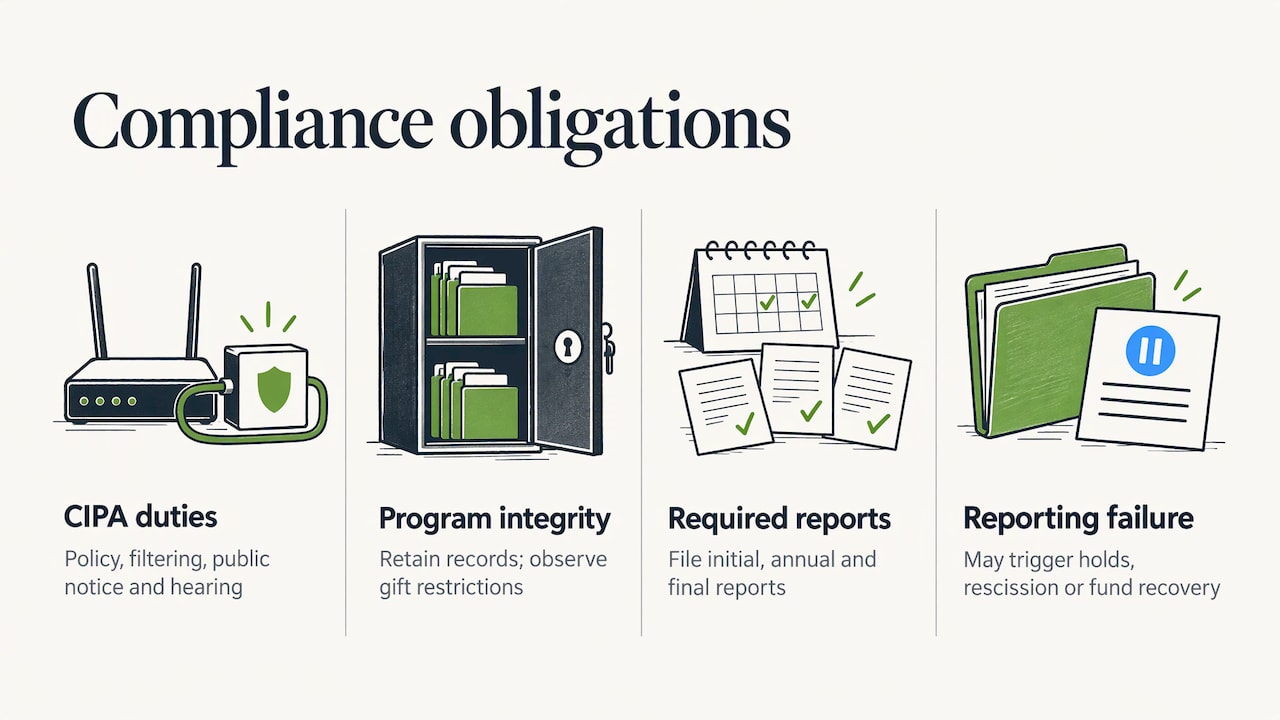
The FCC concluded that CIPA requirements are triggered by purchases through the pilot. The Children’s Internet Protection Act (CIPA) requires an internet safety policy, technology protection measures such as filtering, and public notice and a hearing. For participants new to E-Rate, this is often the least familiar obligation. Our CIPA Compliance service covers policy review, staff training and an online portal, and our CIPA filtering requirements guide explains the filtering side.
The same order set program integrity rules: document retention and production, gift restrictions, certifications, audits, and suspension and debarment. Under 47 CFR 54.2004, participants file initial, annual and final reports. Failure to report may lead to referral to the Enforcement Bureau, disbursement holds, rescission or fund recovery.
In practice, keep one retrievable file per funding request: the Form 470 and the bids received, the scoring that shows price as the primary factor, the signed contract and its date, the P-ESL mapping, invoices, proof of payment and service delivery, and CIPA documentation. Building that file around compliance and audit readiness habits, such as consistent access control and traceable change history, helps when a reviewer asks for it years later. We keep records for our E-Rate clients in a dedicated support portal, which is how we handle document retention compliance.
The Next Deadline: Form 484 Part 3
This is the date most participants should be calendaring now. USAC states that beginning in February 2027, participants must submit Form 484 Part 3 to update the information in Parts 1 and 2 and answer new annual data questions. The due date is the date of the participant’s first FCDL plus 60 days, so two participants in the same state can have different due dates.
Steps to take before then:
- Find the date of your first FCDL. The FRN Status Tool in EPC now aggregates pilot data, and our funding lookup tool page points to your status.
- Pull your Part 1 and Part 2 answers and the metrics you proposed, so updates are consistent.
- Collect the outcome data you will need: incidents, tools deployed, staff trained and spending against your budget.
- Assign one person to file and one to review.
Two procedural changes are worth knowing. As of September 24, 2026, USF participants signing in at usac.org are automatically directed to USAC’s One Portal dashboard. Pilot appeals or waiver requests must be filed within 30 days of USAC’s decision, per the October 2026 newsletter.
How the Pilot Connects to E-Rate Planning
The pilot is separate from E-Rate’s July 1 funding years, but the same staff usually handle both. Pilot invoicing deadlines, Form 484 Part 3 and the regular E-Rate Form 470 and Form 471 cycle can fall in the same months. Our updates on planning for Funding Year 2027 and the FCC’s centralized bidding portal show what is coming for E-Rate bidding. Together with the E-Rate news page, they help you put all of these dates on one calendar.
Whether the FCC makes cybersecurity support permanent depends on what the pilot data shows. Participants that document their results well will be in the strongest position to describe what worked, and the same records protect them in an audit.
Support for Pilot Participants and E-Rate Applicants
Our E-Rate Compliance Services manage the full E-Rate process, from filing applications to securing reimbursements, with proactive deadline management and a dedicated support portal. You can start at e2eexchange.com.
If you are a technology director or business official juggling E-Rate, pilot invoicing and CIPA documentation at once, contact us through our site and we will review where your deadlines and records stand.
FAQ
Can my school still apply to the FCC Cybersecurity Pilot Program?
No. Applications were limited to a fixed window, and the FCC selected more than 700 participants on January 16, 2025. USAC reports that all funding commitment letters have now been issued. Watch the FCC and USAC for any future cybersecurity program.
When is FCC Form 484 Part 3 due?
Participants must begin filing in February 2027. The due date is 60 days after the first FCDL date, so it differs by participant. Check your FCDL date and USAC’s program page for guidance.
Does the pilot require CIPA compliance?
Yes. The FCC’s June 2024 order concluded that CIPA requirements are triggered by purchases through the pilot. Participants should have an internet safety policy and technology protection measures in place and documented.
How do participants get paid back?
Through invoicing, either BEAR (you pay the vendor and file Form 472) or SPI (the provider bills you the non-discount share and files Form 474). Invoices are due within 90 days after the last date to receive service, with one 90-day extension available if requested in time.
Sources
- FCC: Schools and Libraries Cybersecurity Pilot Program
- FCC: Cybersecurity Pilot Program FAQs
- FCC: Pilot Eligible Services List
- FCC June 2024 Report and Order (FCC 24-63)
- FCC Order FCC-24-63A1, per-student budgets
- USAC: Cybersecurity Pilot Program
- USAC: Applicant Process
- USAC: Competitive Bidding
- USAC: Invoicing
- USAC: October 2026 Pilot Program Newsletter
- USAC: March 2026 Pilot Program Newsletter
Recommended
- FCC USAC E-Rate Category 2 Rules
- E-Rate Industry Update: Major FCC Review Underway, Competitive Bidding Changes Coming, and What Schools & Libraries Need to Know Right Now (August 2026)
- E-Rate Bidding Portal 2028: FCC Approves Major Changes for Schools and Libraries
- E-Rate Update: Start Planning for Funding Year 2027 — Form 470 Actions, New Bidding Portal Ahead, and Current Funding Status