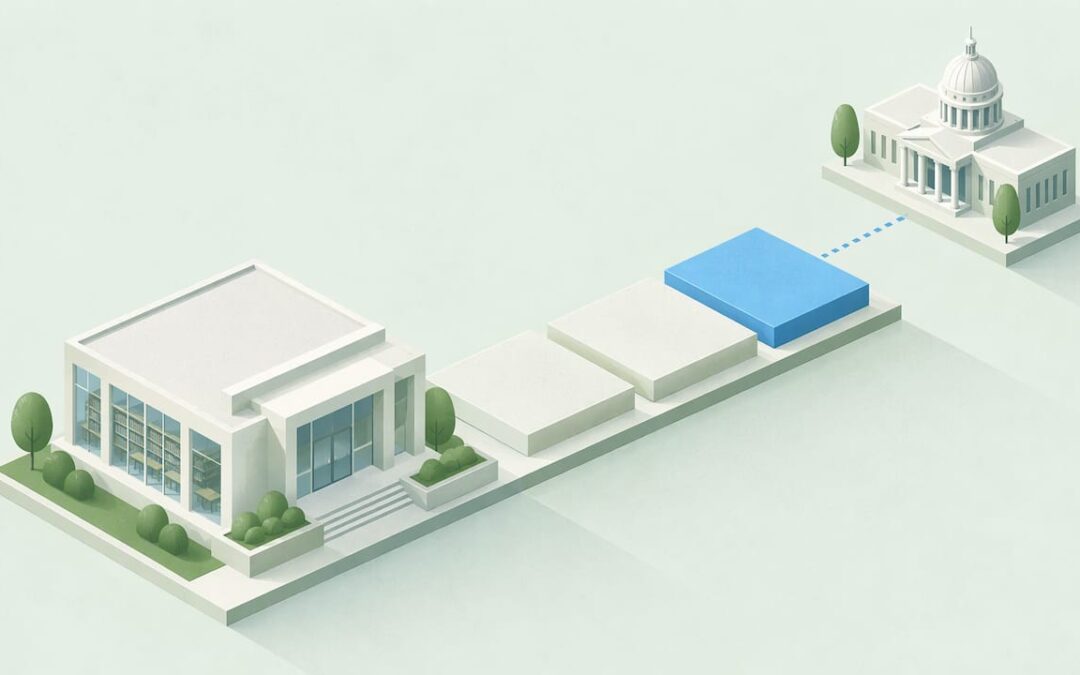
Libraries searching for technology funding usually land on a mix of programs, and one of the largest is not a grant at all. E-Rate is a federal discount program: it reduces what eligible libraries pay for internet access and internal network connections, and it reimburses the approved share of costs after the library has received service. This guide explains who qualifies, what is covered, how the process runs from Form 470 to reimbursement, and which compliance records protect your funding.
Key Takeaways
- E-Rate is a discount and reimbursement program, not a grant. Funding is paid against eligible costs for services you have actually received.
- Libraries generally qualify when they can receive assistance from their state library administrative agency under the Library Services and Technology Act (LSTA).
- Discounts range from 20% to 90% of eligible costs, based on poverty and adjusted for rural locations, so your library always pays a share.
- The process follows a fixed order: Form 470, a 28-day bidding wait, Form 471 in the annual window, then Form 486 and invoicing. Missing a step can cost the whole funding year.
- Libraries that receive discounts on internet access or internal connections must comply with the Children’s Internet Protection Act (CIPA) and keep documentation of it.
Table of Contents
- E-Rate Is a Discount Program, Not a Grant
- Which Libraries Are Eligible for E-Rate
- What E-Rate Covers
- How Much Libraries Can Receive: Discount Rates
- The E-Rate Process, Step by Step
- Deadlines: The Annual Rhythm
- Compliance and Records Libraries Must Keep
- Planning a Library Technology Project Around E-Rate
- How E-Rate Compliance Services Help Libraries
- Staying Current as Program Rules Change
- Frequently Asked Questions
- Sources
E-Rate Is a Discount Program, Not a Grant
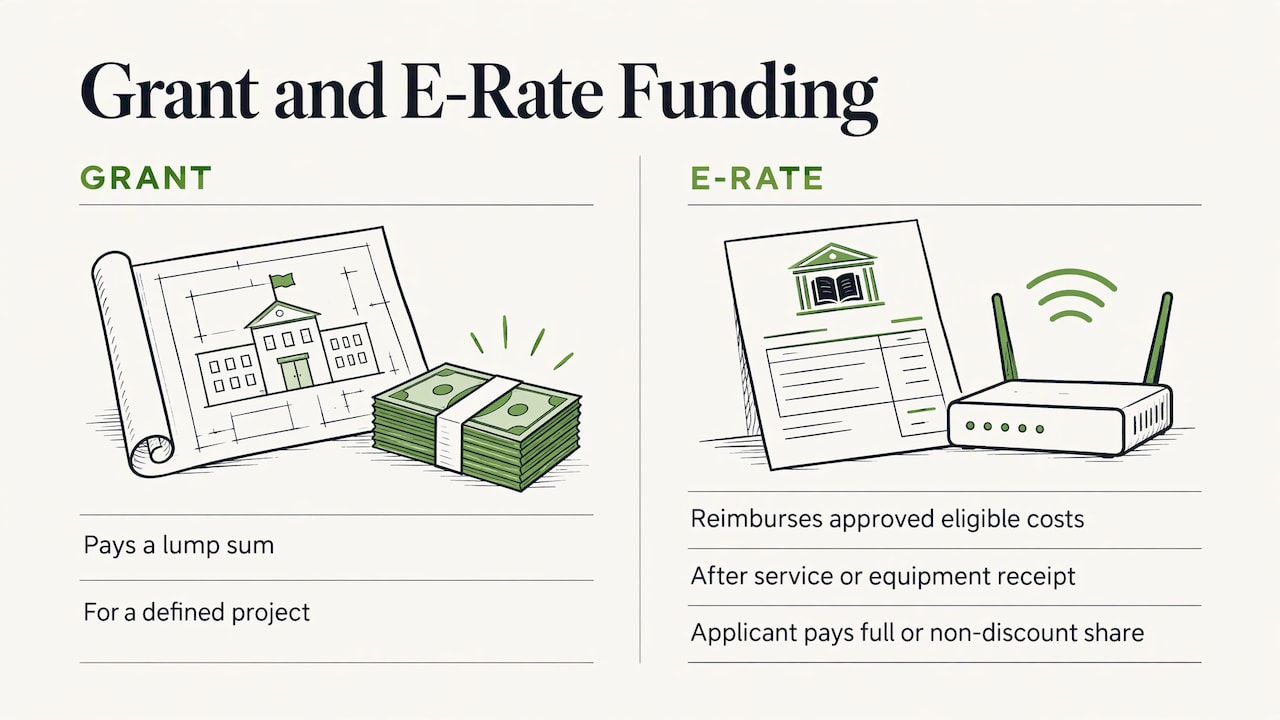
The distinction affects how you budget. A grant typically pays a lump sum for a defined project. E-Rate works differently. According to the Idaho Commission for Libraries, the program reimburses the approved portion of eligible costs after services or equipment are received and the applicant has paid in full or paid its non-discount share.
That means a library must be able to cover costs up front, or arrange for the service provider to bill only the library’s share. Either way, the funding follows an approved application, not a competitive award of cash.
The FCC explains that E-Rate is funded through the Universal Service Fund and provides discounts for telecommunications, internet access and internal connections to eligible schools and libraries. Because it is an entitlement-style discount program with annual funding requests, it rewards libraries that plan early and document carefully.
For many libraries, E-Rate is the most reliable recurring source of connectivity support, which is why this article stays focused on it.
Which Libraries Are Eligible for E-Rate
The FCC states that libraries generally qualify when they can receive assistance from a state library administrative agency under LSTA. In practice, that means:
- Public libraries that are recognized by their state library agency.
- Library branches and, in many cases, library systems, each with its own entity information in the E-Rate system.
- Libraries that meet the state definition and are not operated for profit.
If you are unsure whether your library is recognized, your state library’s E-Rate coordinator is the first call. Many state libraries publish their own E-Rate pages and run training sessions for library staff.
Eligibility also has a second layer: eligible entities must request eligible services. A library can qualify as an applicant and still lose funding on a specific request if the item is not on the Eligible Services List.
What E-Rate Covers
The Universal Service Administrative Company (USAC) publishes the program rules. Its 2025 program overview lists four categories of eligible services:
- Data transmission services and internet access
- Internal connections
- Managed internal broadband services
- Basic maintenance of internal connections
The same overview notes that voice services have not been eligible since Funding Year 2019. Libraries that still budget E-Rate savings for phone service need to remove that assumption.
What E-Rate does not pay for
USAC’s overview also states that applicants must supply the end-user equipment, software, professional development, electrical capacity and other resources needed to use the supported connectivity. A library can win funding for a managed Wi-Fi network and still need its own budget for the laptops, public computers and staff training that make the network useful.
When you plan a technology project, split it into two columns early: the connectivity pieces that may be eligible, and the pieces your library must fund another way.
How Much Libraries Can Receive: Discount Rates
The FCC says E-Rate discounts range from 20% to 90%. The level depends on poverty and can be increased for rural schools and libraries. Recipients must pay part of the service cost.
Here is a simple illustration. Suppose a library has an eligible internet access bill of $10,000 for the funding year and its approved discount is 80%. The library’s non-discount share is $2,000, and the program covers the remaining $8,000 of eligible costs. These figures are an arithmetic example, not a forecast for any library.
Two practical points follow:
- Your discount rate is calculated from the data you report, so accurate entity information matters.
- Costs that include ineligible components must be separated (cost-allocated) so only the eligible portion is requested.
The E-Rate Process, Step by Step
The steps below follow the sequence described by USAC and the Oregon Libraries E-Rate Guidebook.
- Create or access your E-Rate Productivity Center (EPC) account. EPC is where you manage entity information, forms and correspondence with USAC.
- Certify Form 470. USAC says this form describes the services you want and notifies providers. It opens competitive bidding.
- Wait at least 28 days. You may not select a provider or certify Form 471 until 28 days after the Form 470 is posted.
- Evaluate bids. The FCC requires applicants to select the most cost-effective eligible offering with price as the primary factor, while also following state and local procurement rules.
- Select a provider and certify Form 471 during the annual filing window.
- Respond to USAC’s review. Program Integrity Assurance questions can arrive at any point, and answers are time-limited.
- Receive the Funding Commitment Decision Letter (FCDL). This tells you what was approved and at what discount.
- Begin service and file Form 486. The Oregon guidebook states Form 486 is due 120 days after the FCDL date or the service start date, whichever is later.
- Invoice for reimbursement. Libraries use the BEAR form (reimbursing the library) or the SPI process (the provider bills the library only its share and is reimbursed directly).
USAC also states that Form 498 and appeal timelines are fixed: Form 498 is due no later than 120 days after the Form 486 Notification Letter or 120 days after the last date to receive service, whichever is later, and appeals are due within 60 days of USAC’s decision letter.
Competitive bidding is where most libraries slip
The 28-day rule is simple, but libraries often lose time here. A Form 470 posted too late pushes the earliest possible Form 471 past the filing deadline. Bids evaluated on anything other than price as the primary factor, or without documentation of the scoring, can be questioned in review. Keep every bid, the scoring sheet and the reason for your selection in one file.
Deadlines: The Annual Rhythm
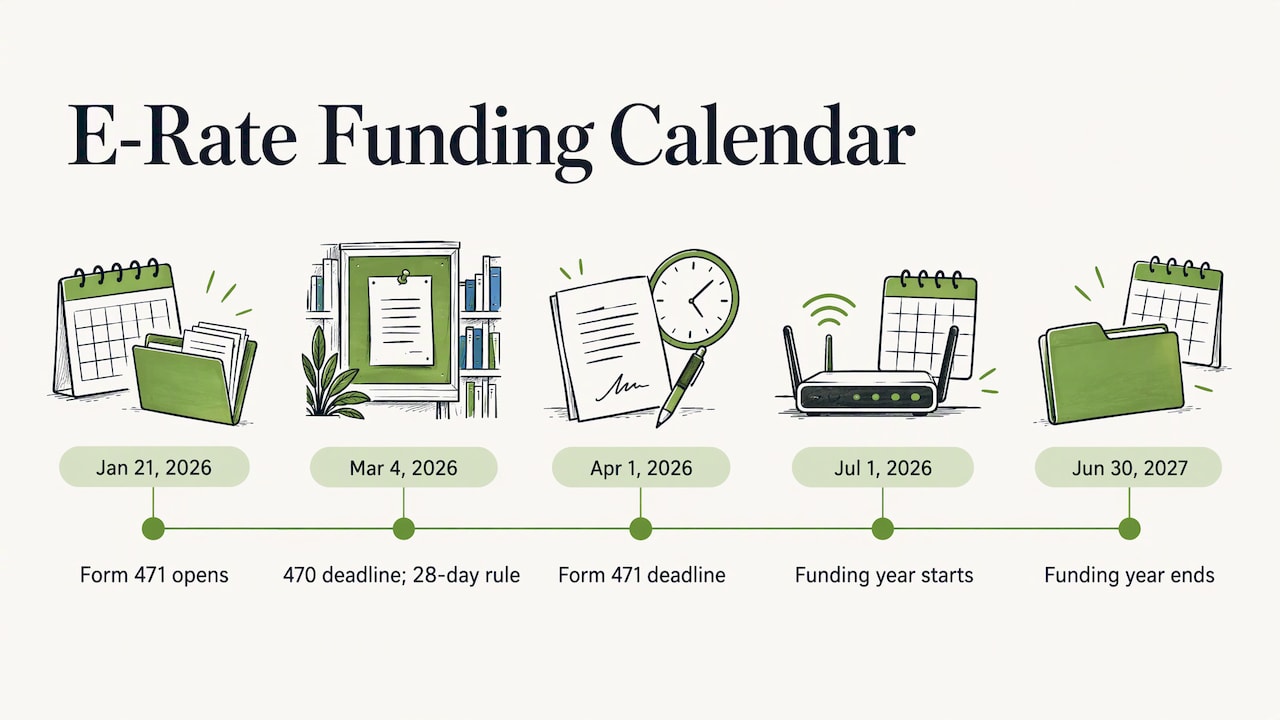
E-Rate runs on funding years that start July 1 and end June 30. The application activity for a funding year happens in the months before it begins, and the window dates change annually, so always confirm them on USAC’s official site.
For reference, here is how FY2026 ran. The State Library of Iowa lists March 4, 2026 as the Form 470 deadline and April 1, 2026 as the Form 471 deadline for the funding year of July 1, 2026 to June 30, 2027. The Oregon guidebook adds that the Form 471 window opened January 21, 2026 at noon Eastern Time and closed April 1, 2026 at 11:59 p.m. Eastern Time, and that the March 4 Form 470 date was set to satisfy the 28-day requirement.
The pattern to plan around: Form 470 in winter, a 28-day bidding wait, and Form 471 by early spring. Libraries that post their Form 470 well ahead of the last possible day leave room to handle questions from bidders and to reissue if a request needs changing.
For current-cycle updates, our Funding Year 2027 planning update covers Form 470 actions and the new bidding portal, and our bidding portal changes article explains what the FCC approved for the future.
Compliance and Records Libraries Must Keep
Receiving E-Rate funds is one thing. Keeping them is another. The Arkansas State Library explains that libraries receiving discounts on internet access, internal connections, basic maintenance or managed internal broadband services must comply with CIPA. That includes maintaining an internet safety policy and filtering, holding a public meeting, and keeping the meeting minutes and public notice.
A practical compliance file for each funding year includes:
- The Form 470 posting, bids received and bid evaluation record
- The signed contract or other legally binding agreement
- The Form 471 certification and FCDL
- The Form 486 filing and invoice records
- The adopted internet safety policy, public notice and meeting minutes
- Records showing how shared costs were allocated between eligible and ineligible items
Form 486 deserves particular care. USAC’s May 2026 Tribal Nations newsletter says early Form 486 filing requires a positive funding commitment, confirmation of a July service start, the applicable contracts or legally binding agreements, and certifications that the facts submitted are true. A certification is a legal statement, so the person who signs it should have the records in front of them.
For CIPA specifics, see how we approach CIPA compliance, including policy review and staff training.
Planning a Library Technology Project Around E-Rate
Library directors often start with a project idea, such as upgrading Wi-Fi in a branch or replacing aging switches, and then look for money. With E-Rate the order should be reversed for the connectivity portion: look at the funding calendar first, then size and time the project.
A workable planning sequence:
- Inventory current services and contracts. Note expiration dates, because contract terms drive when you must rebid.
- List projects and mark eligible pieces. Compare each against the Eligible Services List and separate non-eligible items.
- Estimate your discount and your share. Use your most recent data and confirm the share is in the budget before filing.
- Set a Form 470 posting date that leaves slack before the 28-day clock and the Form 471 window.
- Assign roles. Decide who certifies forms, who evaluates bids and who stores records. Turnover in these roles is a common cause of missed steps.
- Plan for the reimbursement cycle. Know whether you will use BEAR or SPI and what your cash position requires.
Check the status of requests already filed
Once an application is in, the status of each request matters for planning. You can use our E-Rate funding status lookup to see where requests stand, then act on any pending items before the next deadline.
How E-Rate Compliance Services Help Libraries
Small library teams rarely have a dedicated E-Rate specialist. The same director who manages programming and budgets may also be the person responsible for a Form 470 and a bid evaluation. Our E-Rate Compliance Services are built for that situation. We manage the E-Rate process end to end, from filing applications to securing reimbursements, with proactive deadline management and a dedicated support portal.
In practice, we handle the administrative steps described above so library staff can focus on patrons: tracking each window, preparing and filing forms, supporting the bid evaluation and keeping documentation in order. We also support CIPA requirements, since E-Rate eligibility and CIPA compliance are linked. To discuss your library’s situation, start at e2eexchange.com or review our latest E-Rate updates.
Staying Current as Program Rules Change
E-Rate rules evolve through FCC orders and USAC guidance. Recent developments include changes to the competitive bidding process and the bidding portal. Our May 2026 E-Rate update and the complete guide to E-Rate funding in 2026 summarize the changes that matter most to applicants.
Two habits keep libraries ahead of rule changes. First, read the USAC news and your state library’s E-Rate communications each month during the application season. Second, review your internal checklist after every funding year, while the lessons from that cycle are fresh.
Frequently Asked Questions
Is E-Rate a grant for libraries?
No. E-Rate is a discount program funded through the Universal Service Fund. It reimburses the approved portion of eligible costs after you receive services and pay your share, according to the Idaho Commission for Libraries. Your library still pays a portion of each eligible cost.
Does my library qualify for E-Rate?
Libraries generally qualify when they can receive assistance from a state library administrative agency under LSTA, per the FCC. Your state library can confirm your status. You must also request services that appear on the Eligible Services List.
What discount can a library receive?
The FCC says discounts range from 20% to 90%, based on poverty and potentially higher for rural libraries. Every recipient pays part of the cost. Your approved rate appears in your Funding Commitment Decision Letter.
What are the first steps to apply?
Create or access your EPC account, then certify Form 470 to start competitive bidding. After at least 28 days, you can select a provider and certify Form 471 during the annual window. Confirm the current year’s dates on USAC’s official site.
Does E-Rate require CIPA compliance?
Yes, for libraries receiving discounts on internet access, internal connections, basic maintenance or managed internal broadband services. The Arkansas State Library notes this means an internet safety policy, filtering, a public meeting, and retained minutes and notice.
Sources
- Idaho Commission for Libraries: What is E-rate?
- FCC: E-Rate Universal Service Program for Schools and Libraries
- FCC: Universal Service Fund
- USAC: Schools and Libraries (E-Rate) Program Overview, 2025
- Oregon Libraries E-Rate Guidebook, FY2026-2027
- State Library of Iowa: E-Rate
- Arkansas State Library: E-Rate for Public Libraries
- USAC Tribal Nations Newsletter, May 2026
Recommended
- The Complete Guide to E-Rate Funding for Schools and Libraries in 2026
- E-Rate Updates May 2026: Major FCC Changes, Budget Increases & What Schools & Libraries Need to Know
- E-Rate FY2026: Key Updates, Deadlines & Strategies to Maximize Funding for Schools & Libraries
- E-Rate Funding Year 2025 Wrap-Up & FY 2026 Updates: What Schools & Libraries Need to Know