

Grant compliance means using grant money for its approved purpose, following the terms of the award, keeping the records that prove it, and reporting on time. For a school, library or educational service agency, that comes down to five things: read the award terms, assign owners, calendar every report, keep documentation, and monitor internally before an auditor does. This guide explains each step. It also covers the rules specific to E-Rate, where missed certifications and thin records are a common source of trouble.
Key Takeaways
- Your Notice of Award or subgrant agreement is the controlling document. Federal rules, program rules and your own written procedures all sit under it.
- Reporting schedules vary by grant, so build a calendar from each award instead of assuming one timetable fits every program.
- Written procedures for cost allowability, procurement and conflicts of interest are expected of recipients, and they are your first line of defense in an audit.
- E-Rate adds its own layer: competitive bidding, FCC Form 471, FCC Form 486 and a long record retention period.
- Ongoing internal monitoring costs far less than repayment, disallowed costs or a suspended award.
Table of Contents
- What grant compliance means in practice
- What to check in every award
- Grant reporting requirements and deadlines
- Records that prove you complied
- E-Rate compliance: where it differs
- What happens when compliance fails
- A repeatable compliance routine
- Our perspective
- Support for your funding and compliance work
- FAQ
- Sources
What grant compliance means in practice
Grant money is conditional. It comes with rules on what you may spend it on, how you document the spending and what you report back. NIH describes compliance as following applicable federal statutes, regulations and policies, institutional requirements, the Notice of Award and its grants policy statement. It also says recipients are responsible for monitoring compliance, conducting the project according to the approved application and budget, and informing the agency of problems.
The same page frames oversight as a shared responsibility between the awarding agency and the recipient, built on trust. In practice, the agency trusts you to run the award properly, and you prove it with paperwork.
For education organizations, compliance is rarely one rulebook. A single district may manage several layers at once:
- Federal statutes and regulations, including the Uniform Guidance and EDGAR.
- Program rules, such as those for ESSA or IDEA funds.
- The terms in each Notice of Award or subgrant agreement.
- State education agency requirements on top of the federal ones.
- Your board policies and internal procedures.
Texas guidance for districts and education service centers lists exactly these tiers: federal statutes like EDGAR and the Uniform Guidance, program-specific regulations, and the terms of the award or subgrant. Its checklist of areas to verify includes budget requirements, cost allowability, procurement policies and internal controls.
What to check in every award
Before the first dollar is spent, read the award document line by line. Treat it as a checklist and confirm each of the following.
Purpose, budget and period
Confirm the approved purpose, the approved budget categories, and the start and end of the period of performance. Spending outside those limits is the most common way an otherwise well-run program ends up with disallowed costs. If your plans change, ask the awarding agency before you act, not after.
Cost allowability
Recipients are expected to have written procedures for payment and for determining cost allowability. A cost generally has to be necessary, reasonable, allocable to the grant and properly documented. Write down who decides, what evidence is needed and where it is filed.
Procurement and conflicts of interest
The same Maine handbook calls for documented procurement procedures and written standards of conduct covering conflicts of interest. If a purchase uses grant funds, your procurement file should show how you solicited, compared and selected. Do this before you sign a contract.
Internal controls
South Carolina’s education department notes that effective internal controls should align with frameworks such as the Green Book or the COSO Internal Control Integrated Framework and address compliance with statutes, regulations and award terms. That means segregation of duties, approval workflows and periodic review, all written down.
Employee notices
The same South Carolina guidance says recipients and subrecipients must inform employees in writing of whistleblower rights and protections under 41 U.S.C. 4712. It is easy to overlook and easy to fix.
Audit thresholds
Non-federal entities that spend $1 million or more in federal awards in a fiscal year must have a single audit or program-specific audit. Your state may add its own submission steps. In Texas, for example, districts and education service centers submit single audit reports to both the Federal Audit Clearinghouse and the state agency’s financial compliance division, according to the TEA guidelines.
Grant reporting requirements and deadlines
There is no single reporting calendar. Grants.gov states that reporting requirements and schedules vary by grant. Agencies track progress and spending through programmatic and financial reports and performance metrics. At closeout, recipients submit final financial and programmatic reports, which are due within 90 days after the award expires or is terminated.
Some examples show how much the schedules differ:
| Source | What is reported | Timing |
|---|---|---|
| Grants.gov, post-award phase | Final financial, performance and other reports | Within 90 days after the award expires or is terminated |
| ACF | Federal Financial Reports | Quarterly, semi-annual or annual per the Notice of Award; final cumulative report generally 120 days after the project period closes unless program rules say otherwise |
| NIH | Research Performance Progress Report | At least annually |
| NIH | Federal Financial Report | Generally annual; when annual, due no later than 90 days after the end of the calendar quarter in which the budget period ends |
The NIH rows apply to research awards, but they show the pattern: a progress report covering accomplishments, plans, challenges and delays, and a separate financial report with its own clock. Your award may use different forms and dates. The Notice of Award is the final word.
Build the calendar once, from the documents
The practical fix is a single reporting calendar. For each award, enter the following:
- Every interim and final report, with the due date taken from the award, not from memory.
- The internal deadline, set two to three weeks earlier, so finance and program staff can review.
- The person responsible and a named backup.
- The location of the supporting documents.
- Any liquidation, drawdown or obligation deadlines tied to the award.
South Carolina’s guidance recommends creating a calendar of requirements, communicating regularly across program and finance offices, and documenting grant activities. That is the same advice, and it works because most missed reports come from handoffs between offices, not from bad intent.
Records that prove you complied
If you cannot show it, it did not happen. Auditors and program reviewers work from documents: invoices, time and effort records, procurement files, board approvals, inventory records and evidence of services delivered.
Grants.gov lists the building blocks of a sound compliance program: accounting and internal controls, records control and retention, an internal compliance and ethics program, and reporting suspected fraud to the Inspector General of the agency that distributed the funds.
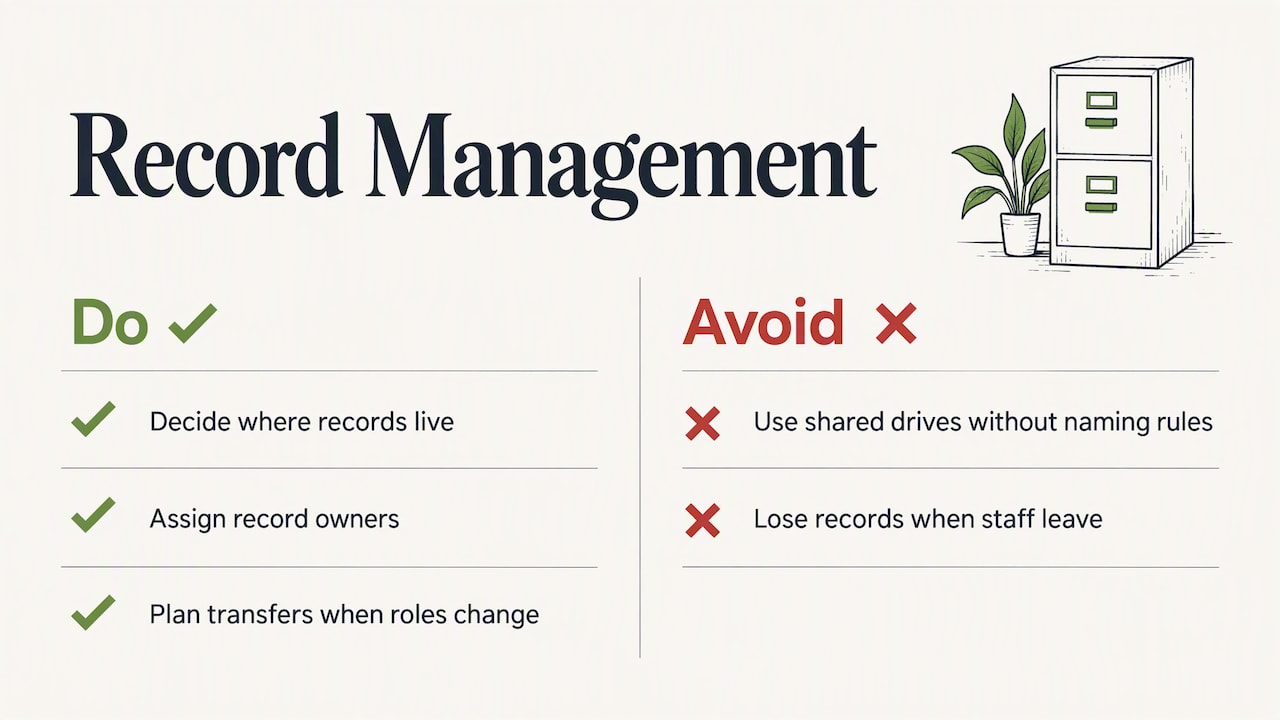
Retention periods depend on the program. For E-Rate, USAC states that participants must keep all program records for at least 10 years after the later of the last day of the applicable funding year or the service delivery deadline. Many districts file everything on a shared drive with no naming rules and then lose it when a staff member leaves. Decide where records live, who owns them and how they transfer when people change roles.
The California Department of Education recommends that grant manuals include organizational charts, descriptions of the grant application process and descriptions of financial management systems so staff responsibilities are clear. It also advises assembling a team of both fiscal and programmatic staff to draft grant policies, so the procedures reflect how the money is actually spent and how the program actually runs.
E-Rate compliance: where it differs
E-Rate is a discount program, not a conventional grant, but it carries many of the same obligations plus its own. USAC’s program overview says E-Rate compliance involves competitive bidding rules, the annual filing of FCC Form 471, and certification of service receipt on FCC Form 486. Service providers also file an annual FCC Form 473 (SPAC) to certify their compliance with program rules.
The Form 486 deadline catches applicants who treat it as an afterthought. It must be certified no later than 120 days after the Funding Commitment Decision Letter or 120 days after the service start date, whichever is later, per the same USAC guide. A calendar entry created the day the commitment letter arrives prevents the miss.
The usual E-Rate pressure points are:
- Competitive bidding. A Form 470 posting, a fair evaluation and documentation of why you chose the winning bid. Rules are under review at the FCC, and our August 2026 industry update tracks the changes to competitive bidding.
- Planning ahead. The next cycle starts earlier than most offices expect. We cover Funding Year 2027 Form 470 actions and the new bidding portal in a separate update.
- CIPA. E-Rate applicants must certify Children’s Internet Protection Act compliance, which means having the right policies, filtering and public notice and hearing records in the file.
- Document retention. The 10-year rule above applies to bid files, invoices, service records and certifications alike.
To see where an application stands, use our E-Rate funding lookup tool.
What happens when compliance fails
Consequences range from administrative to criminal, and the lighter end is still expensive. Failure to follow grant rules can lead to disallowed costs, repayment, withheld payments, or suspension or termination of the award, which means money you may have already spent has to come back from your general fund.
At the serious end, Grants.gov states that grant fraud, including embezzlement, false statements and charging personal expenses to a grant, is subject to criminal prosecution, fines, restitution and civil penalties. Stewardship is a core duty: use funds for the intended purpose, account for costs and justify expenditures.
Most districts never come near that. Their realistic risk is an audit finding that traces back to a missing invoice, an unsigned certification or a purchase made before the procurement steps were complete. All of these are preventable with routine.
A repeatable compliance routine
This routine fits a small library or a large district. Scale the detail, not the steps.
- Open the award file. Save the Notice of Award, the approved application and budget, and the program rules in one folder per award.
- Name an owner. One person for programmatic compliance, one for fiscal compliance, each with a backup.
- Write the procedures. Cost allowability, procurement, conflicts of interest, time and effort, inventory, records retention.
- Calendar everything. Reports, certifications, audits, drawdowns and closeout, with internal deadlines ahead of the real ones.
- Check quarterly. Compare spending to the approved budget, confirm documentation is complete and note any change that needs agency approval.
- Train staff. Anyone who buys, approves or charges to a grant should know the rules that touch their step.
- Close out cleanly. Submit final reports within the stated window and archive records for the full retention period.
South Carolina’s guidance also stresses establishing routines for reports and monitoring. The purpose is simple: you find problems while they can still be corrected.
Our perspective
We see the same pattern across schools and libraries: the programs are run by capable people who are also teaching, managing buildings or serving patrons. Compliance is one of ten jobs on their desk, and the deadlines do not move.
That is why we manage E-Rate and related funding programs end to end. Filing a form correctly is only one part of it. The harder part is proactive deadline management, document retention, communication between the business office and the technology team, and being ready when a reviewer asks for the file from three years ago.
Our approach is built around that full cycle: accurate filing, tracked deadlines and a dedicated support portal where records stay organized. When compliance is handled as a continuous process, funding is easier to pursue with confidence, and administrators can spend their time on students instead of paperwork.
Scott
Support for your funding and compliance work
If your organization uses E-Rate, grants or both, e2e Exchange can take on the administrative load. Our E-Rate services cover application filing, deadline management and reimbursement. For funding beyond E-Rate, our grant funding support helps you identify and pursue programs, and our CIPA compliance services cover policy review, staff training and an online portal.
Rural districts may also want to look at our SRSA grant program work, and California organizations can ask about the California Teleconnect Fund. To talk through your situation, start at e2eexchange.com.
FAQ
What is the definition of grant compliance?
Grant compliance is following the laws, program rules and award terms that come with grant funding. It includes spending only on approved purposes, documenting costs, reporting on schedule and keeping records. The Notice of Award is a central reference, alongside applicable federal statutes and regulations.
What are the grant reporting requirements?
They depend on the grant. Typical items are periodic financial and progress reports and a final report at closeout. Grants.gov notes final reports are due within 90 days after the award ends, while some programs set different windows, so confirm the dates in your own award.
How long should we keep grant records?
It depends on the program and your state. For E-Rate, USAC requires at least 10 years after the later of the funding year’s last day or the service delivery deadline. For other awards, check the award terms and your state education agency’s guidance.
Who is responsible for compliance in a district?
The recipient organization is responsible, which in practice means shared ownership between program and finance staff. The California Department of Education suggests drafting grant policies with both fiscal and programmatic personnel. Name a specific owner for each award and a backup.
Do E-Rate applicants have extra compliance steps?
Yes. Beyond general grant management, E-Rate requires competitive bidding, annual Form 471 filing and Form 486 certification, according to the USAC program overview. CIPA certification is also part of the picture.
Sources
- Grants Compliance & Oversight, NIH
- General & Fiscal Guidelines, Texas Education Agency
- Federal Grant Management Handbook, Maine Department of Education
- Understanding Your Subgrant Agreement and Compliance, South Carolina Department of Education
- Post Award Phase, Grants.gov
- Reporting, Administration for Children and Families
- Reporting Requirements, NIH
- Grant Fraud Responsibilities, Grants.gov
- Schools and Libraries (E-Rate) Program Overview, USAC
- CDE Federal Grants Fiscal Guidance, California Department of Education
- Grant Compliance: Federal Grant Rules, Explained
Recommended
- CIPA Compliance Services: Protect Your E-Rate Funding and Ensure Internet Safety for Students
- Grant Funding for Schools: Unlock Additional Resources Beyond E-Rate
- E-Rate FY2026: Key Updates, Deadlines & Strategies to Maximize Funding for Schools & Libraries
- E-Rate Updates May 2026: Major FCC Changes, Budget Increases & What Schools & Libraries Need to Know